

The IRS Added Two New Boxes to the W-2. Most Small Businesses Aren't Tracking What Goes In Them Yet.
If you run payroll for anyone who earns tips or works overtime, the W-2 you file in February 2027 is going to look different. The IRS finalized a 2026 Form W-2 with two new boxes: one for cash tips that may qualify for the new federal tip deduction, and one for the overtime premium that may qualify for the new overtime deduction. Both changes come from the One Big Beautiful Bill Act, and both take effect with wages paid during 2026, which is happening right now.
That timing is the catch. The form isn't due until next February, but the data it needs comes from pay periods you're running this fall. If your payroll setup isn't capturing the right numbers today, there's no clean way to go back and rebuild them later.
What actually goes in the new boxes
The IRS added box 12 code TT for qualified overtime compensation and code TP for cash tips reported to the employer, with a related code for tipped employees at a specified service trade or business. Box 14 also splits in two: 14a for the items it always carried, and a new 14b for a tipped occupation code the Treasury assigns by job type.
The catch is in what counts. Code TT is not every dollar of overtime pay. It's only the premium portion required under the federal Fair Labor Standards Act, the extra half on top of straight time for hours over 40 in a week. If your state requires daily overtime, or a union contract pays double time, or you pay overtime more generously than the law requires, the extra above the FLSA premium doesn't qualify and has to be separated out.
Code TP has a similar catch for tips. It covers voluntary tips, cash or charged, that the employee reports to you. It does not cover mandatory service charges, auto-gratuities, or other fees that get distributed like tips but aren't actually tips under the law. A payroll system that lumps all of that together will report the wrong number.
Why this is a tracking problem, not a tax problem
Most small business owners who've heard about "no tax on tips" and "no tax on overtime" think of it as something that happens on an employee's personal tax return. It is, but the employer's job is upstream of that: your payroll records are the only source for the numbers that go on the W-2, and the IRS isn't going to accept a guess in February for wages paid back in March.
The IRS gave employers a pass on this for 2025 wages, since the new boxes didn't exist yet on that year's form. That pass doesn't carry into 2026. If your bookkeeper, payroll provider, or point-of-sale tip pooling setup isn't already distinguishing FLSA overtime premium from other overtime, and voluntary tips from service charges, the gap grows every pay period between now and year end.
What to check before the next pay run
Three things are worth confirming now, not in January:
- Does your payroll provider's 2026 update actually separate FLSA overtime premium from any extra overtime you pay under state law, a union contract, or your own policy.
- Does your tip reporting process distinguish voluntary tips from any mandatory service charge, auto-gratuity, or banquet fee you add to a bill.
- Do your employees' job titles map to a Treasury tipped occupation code, which now needs to show up in the new box 14b.
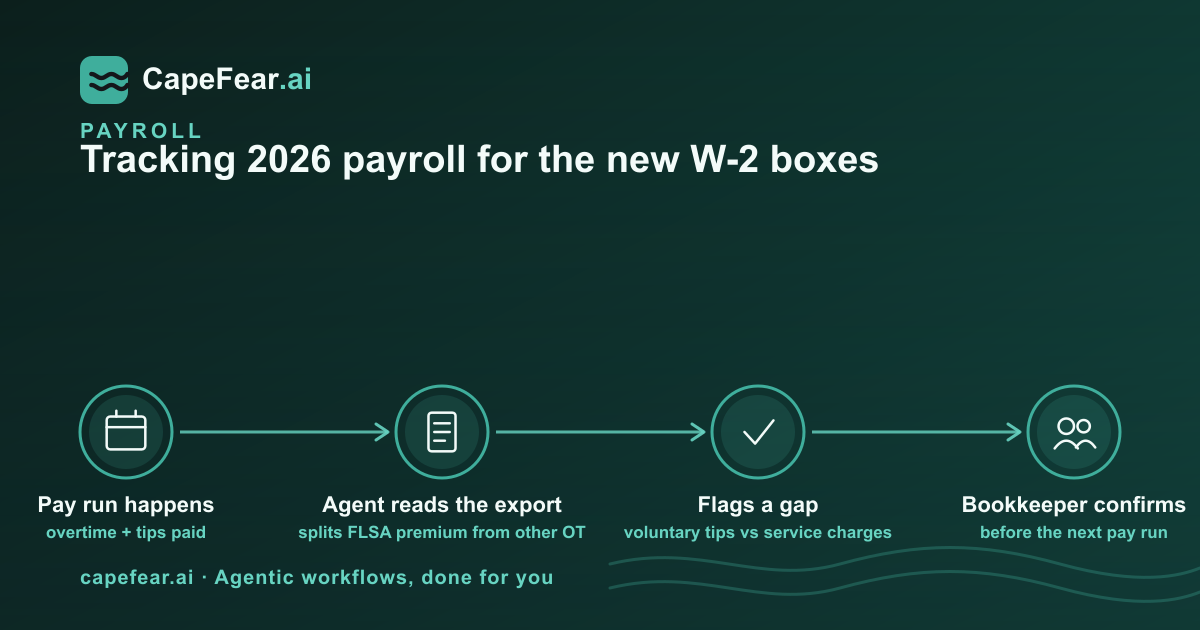
None of this changes how much you owe or withhold today. It changes whether the W-2 you file in February is accurate, and whether your employees can actually claim the deduction the law gives them. An agent that reads your payroll exports each pay period and flags a mismatch, like overtime hours with no premium split, or a tip total that doesn't separate from service charges, catches the gap while there's still a pay period left to fix it. The business owner or bookkeeper still decides what to correct and signs off on anything that touches a paycheck; the agent's job is just making sure nothing slips through unnoticed until the form is due.
Sources: Experian, "IRS Finalizes 2026 Form W-2" and National Law Review, "No Tax on Tips and No Tax on Overtime: Employer Reporting Obligations Are Not Free".