

Utah Just Created a Property Manager License That Didn't Exist Before
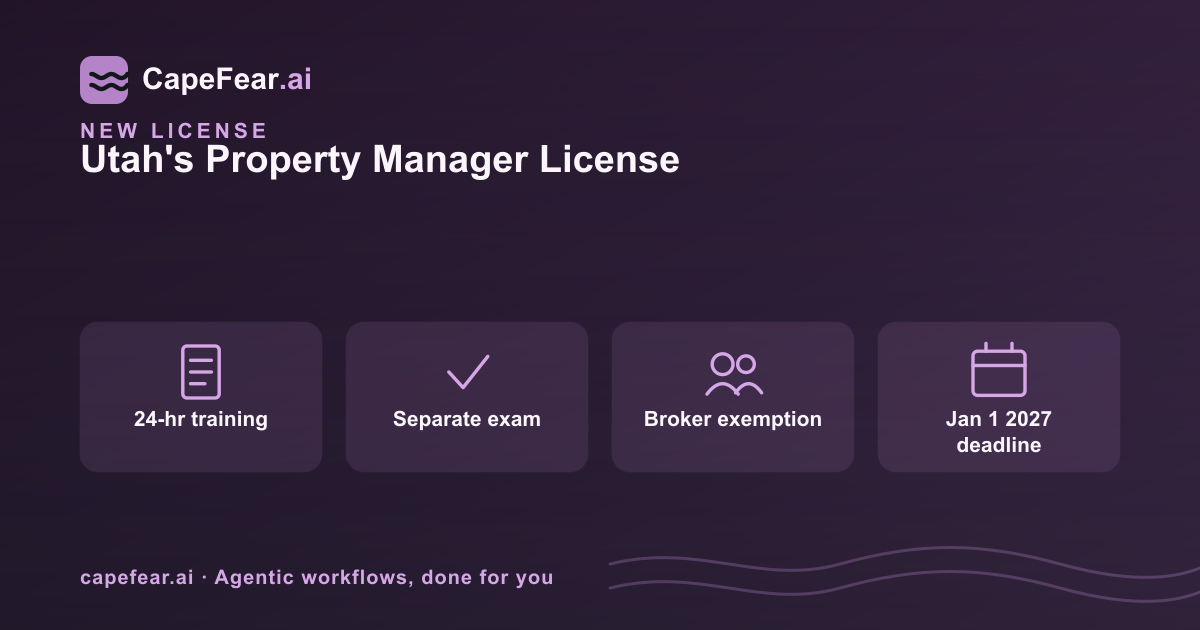
Most states handle property management the same way they've always handled it: if you lease, show, or collect rent on someone else's property for a fee, you need a real estate broker's license, full stop. Utah just broke from that pattern. Starting January 1, 2027, the state has a license track built specifically for property managers, with its own training requirement, its own exam, and its own carve-outs. It's a small structural change with a real deadline attached, and it's worth a look even if you don't operate in Utah, because it's the kind of licensing split other states tend to copy once one state proves it out.
What HB 377 actually changes
Under the enacted Utah Code section covering property managers (61-2f-203), the state's Division of Real Estate has to build a dedicated property manager education program of at least 24 hours before the law takes effect. The exam that follows has to track that curriculum: whatever share of the 24 hours goes to a topic, that topic gets the same share of exam questions. Anyone who already holds a property manager license in another state can be routed into a shorter, state-specific version of the course instead of starting from zero.
The practical effect: Utah is no longer asking every property manager to become a full real estate broker first. It's building a narrower, faster on-ramp that's sized to the actual job.
Who's exempt, and who isn't
The law carries one exemption worth knowing by name. On or after January 1, 2027, anyone who already holds an active broker, associate broker, or sales agent license in Utah can get the new property manager license without taking the 24-hour course or sitting the exam. If your property management operation is staffed by licensed real estate agents who picked up management work as a sideline, this exemption is probably all you need to track.
It's a different story if your team includes people who lease units, negotiate rent, or handle tenant money without holding any real estate license today. Utah's dual-broker provision in the same bill lets a broker who's already affiliated with a property management firm operate without the new license, but that provision doesn't extend down to every employee doing the leasing and collections work. The honest move here is to make a list: who on your team touches leasing, rent collection, or lease negotiation, and does that person hold a license today. If the answer is no, the 24-hour course and exam are the path, and they open well before the January 2027 deadline.
Why this is worth watching outside Utah
A dedicated property manager license is still unusual. Most states fold property management into the general real estate broker license, which is a mismatch: a broker exam is built around sales transactions, not trust accounting for rent deposits or habitability notice timelines. Utah's legislature effectively agreed with that criticism and built a license sized to the job instead. When one state ships a cleaner version of a licensing structure that other states have been patching around the edges for years, it tends to show up in neighboring statehouses within a session or two. If you manage property across state lines, or you're watching your own state's real estate commission for a similar proposal, this is the bill to reference when the question comes up.
What to do before the deadline
Three things are worth doing now rather than in December 2026:
- Pull a current roster of who on staff leases, negotiates, or collects on your properties, and note which of them already hold an active real estate license.
- Watch the Division of Real Estate's rulemaking for the specific 24-hour curriculum and the shorter track for out-of-state property manager license holders, since the commission still has to finalize both.
- If you operate a multi-state portfolio, flag this bill in whatever file you keep on upcoming licensing changes. It's the kind of thing a state regulator asks about in an audit long before most firms think to check.
None of this is a one-person job for long once a firm has more than a handful of staff and a few dozen units. Tracking who's licensed, when a license or required training hour count needs renewing, and which employees still need to get through the new course before 2027 is exactly the kind of recurring, rule-bound task that's easy to let slide until a regulator asks. An agent can hold that roster, flag the people without a current license months ahead of the deadline, and draft the renewal or enrollment emails, but a person on your team still reviews and sends anything that goes out. See how this works for property management teams or how the agent and approval step work together.
Sources: Utah Code 61-2f-203, Property Manager License, Utah HB 377 (2026 General Session, enrolled text).