

Louisiana Now Puts Last Year's Premium Next to This Year's. Your Agency Owns the Call That Follows.
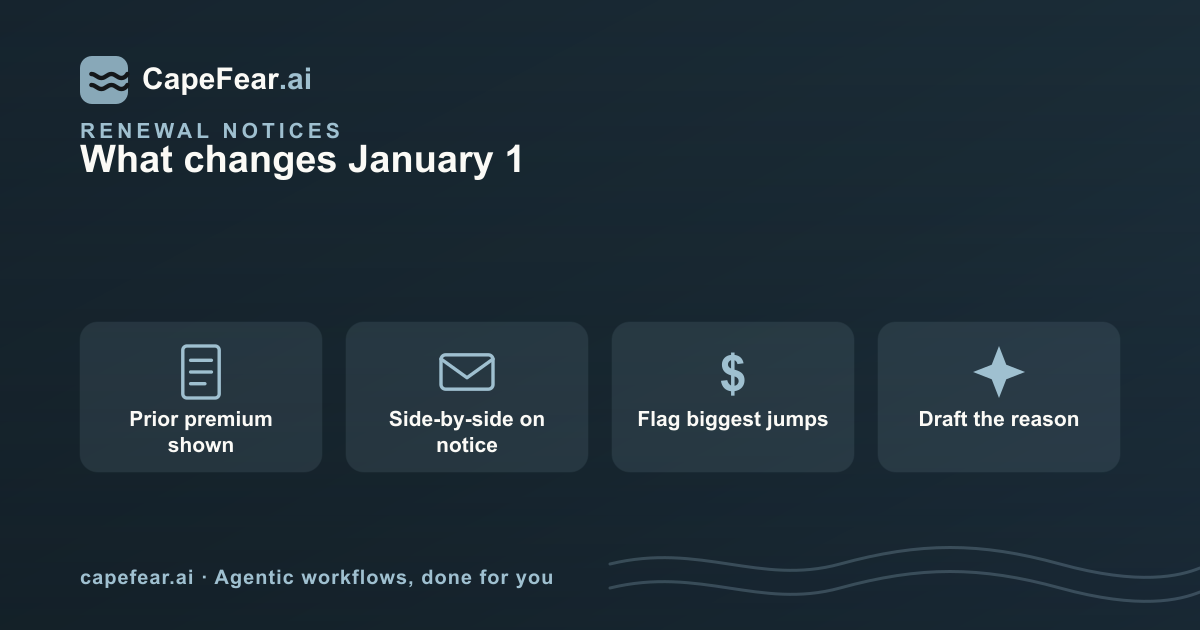
For years, a homeowners or auto renewal notice in Louisiana showed one number: what you owe now. If the premium jumped 30 percent, the policyholder had to dig up last year's bill to even notice. Starting January 1, 2026, that changes. Under La. R.S. 22:881.1(B), as amended by Act 11 of the 2025 legislative session, insurers writing homeowners' and private passenger auto policies in Louisiana must show the premium from the policy they last issued, "prominently displayed in close proximity to" the renewal premium. Side by side, on the same notice.
The Louisiana Department of Insurance gave carriers a grace period to reprogram their systems, but full compliance is due January 1, 2026. Excess and surplus lines are exempt. Standard homeowners and auto renewals are not.
Why this is an agency problem, not just a carrier problem
The carrier prints the notice. The agency's phone rings. A client who gets a renewal letter with last year's $1,400 premium sitting right next to this year's $2,100 premium doesn't call the insurance company's 800 number first. They call the person whose name is on the business card: their agent. And they call expecting an explanation that same day, not a form letter.
Right now that explanation requires someone on your staff to pull the file, check what changed (a roof claim, a credit tier shift, a rate filing, a coverage change the client requested last spring), and call back with specifics. Multiply that by every home and auto renewal going out in Louisiana between now and year end, and the call volume lands all at once, not spread evenly across the year.
What to check before the notices go out
- Confirm your carriers are actually compliant. The law is on the carrier, but if a renewal notice goes out without the comparison and a client complains to the Department of Insurance, your agency is the name they remember, not the underwriter's.
- Pull your highest-increase renewals early. If you can flag the accounts with the biggest percentage jump before the notice lands in the client's mailbox, you can call them first instead of reacting to their call.
- Write down the actual reason for each increase. "Rates went up" is not an answer a client accepts twice. A specific reason, tied to their file, is.
- Decide who handles the call. A straightforward rate-environment increase doesn't need the same person as a non-renewal or a coverage dispute. Sorting that before the volume hits saves the agent's time for the calls that need a human decision.
Where this fits with how we think about agency work
This is exactly the kind of spike an AI agent is built to absorb, not replace. The agent can read the renewal file, draft the specific reason for the increase in plain language, and have that draft ready before the client calls, so the person answering the phone isn't starting from zero. It can flag the accounts with the largest jump so your team calls ahead instead of catching every one reactively. What it does not do is decide what the client's rate should be, negotiate a change, or send anything to a client without someone on your team reading it first. The agent reads and proposes. A person on your staff approves anything that goes out the door.
If you want to see how that read-and-propose pattern works for renewal and retention workflows generally, our insurance page walks through it, and how it works covers the approval step in more detail.
Sources: Louisiana Revised Statutes 22:881.1 (Louisiana State Legislature) and "Louisiana Mandates Premium Disclosure on Insurance Renewals Starting 2026" (ResourcePro, summarizing LDI Advisory Letter 2025-03).