

Why Small Family Law Firms Lose Clients Before the First Phone Call Ends
The first client a family law firm loses usually is not the one who fires them. It is the one who called on a Thursday afternoon, got voicemail, and hired someone else by Friday morning.
That is the intake gap. And for small family law practices running lean, it is one of the most expensive problems they have, because it rarely shows up on a report. The lost client never became a client at all.
The numbers behind the gap
A study by Law Leaders placed 1,200 calls to small and mid-sized law firms during peak business hours. Thirty-five percent of those calls went completely unanswered. Not routed, not returned. Just unanswered.
The same study found that 78 percent of legal clients retain whichever attorney responds to them first. Not the best attorney. Not the least expensive. The first one to get back to them.
A 2024 study by Hennessey Digital, which looked at response behavior across more than 1,300 law firms, found that 27 percent of firms never replied to an online inquiry at all. Of those that did respond, only 28 percent did so within five minutes of the submission.
For a potential client who may be in the middle of a difficult life moment, waiting a day for a callback is often enough to send them to a competitor who picked up faster.
What actually happens during the gap
The intake gap is rarely caused by indifference. It is caused by timing. The person who normally handles calls is in a consultation, out of office, or working through a backlog. A call comes in at 2 p.m. on a busy day, goes to voicemail, and the callback window closes before anyone has a chance to return it.
Online contact forms have the same problem. Someone submits an inquiry on a Tuesday evening. It sits in a shared inbox until Wednesday afternoon. By then, a firm that replied within an hour has already scheduled the consult.
Small firms do not have dedicated intake teams. The attorney is often the intake team, which means every inquiry competes directly with client work already in progress. The common fixes, hiring a receptionist or outsourcing to an answering service, add ongoing cost and still leave an after-hours gap. A voicemail at 8 p.m. on a Friday is still a voicemail.
Where an AI agent fits into this workflow
An AI intake agent is not a chatbot on the website. It is a background workflow that handles the mechanical steps of first contact, so a form or email inquiry does not sit untouched in a shared inbox for a day or more.
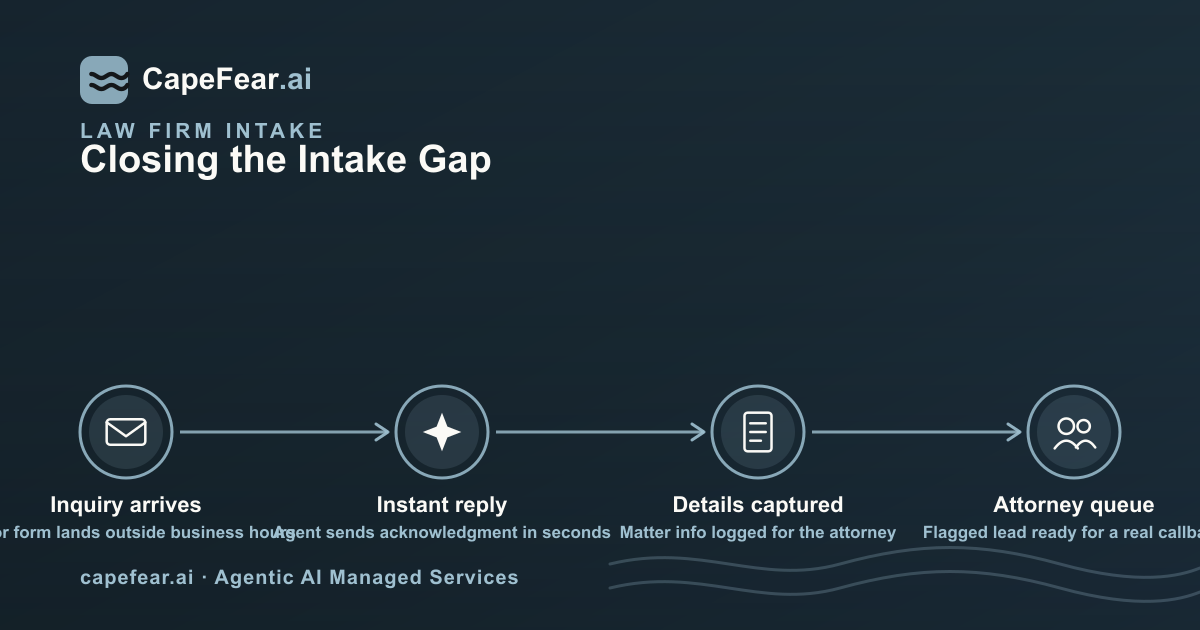
The pattern works like this: a new contact-form or email inquiry triggers the agent. It reads the message, captures the relevant details, such as name, type of matter, and preferred contact time, and drafts a short, warm acknowledgment that queues for the attorney's one-click approval before anything goes out. The lead lands in the attorney's queue flagged and ready, so the callback happens intentionally rather than accidentally.
The agent does not advise on the law. It does not quote fees. It does not screen the matter or commit the firm to anything. It handles the capture-and-draft step that most often falls through the cracks and, based on the data above, can be the difference in whether a potential client stays in the pipeline at all.
For after-hours and weekend contacts, the same background work runs without anyone needing to be at a desk. The draft reply and the flagged lead are both waiting when the attorney opens the queue, instead of a message sitting untouched until Monday. The attorney sees the lead first thing in the morning with context already collected and a response ready to send.
What the agent does not do (and why that matters)
The boundary is intentional: the agent reads and surfaces, a person decides.
The attorney still makes every callback. The attorney decides whether to take the case, what the engagement looks like, and when to send a retainer. The agent handles the part that requires no legal judgment, the draft acknowledgment, the basic detail capture, the calendar prompt, and the queue entry.
This is not about replacing the attorney in the intake process. It is about removing the gap between when a potential client reaches out and when they hear something back. That gap is where smaller practices consistently lose business to firms with larger support staff, not because the smaller firm is less capable, but because the first response came from somewhere else.
For a firm running on two or three attorneys, closing that gap without adding a full-time hire is one of the more practical applications of AI in a legal practice today. The tech is not the hard part. The workflow is.
Read more about how we work with law firms or how the done-for-you model works.
Sources: Bigger Law Firm Magazine, Law Leaders study on unanswered law firm calls; Hennessey Digital, 2024 Law Firm Lead Form Response Time Study.