

California Is Replacing the Certified-Mail Rule for Custody Mediation Notices
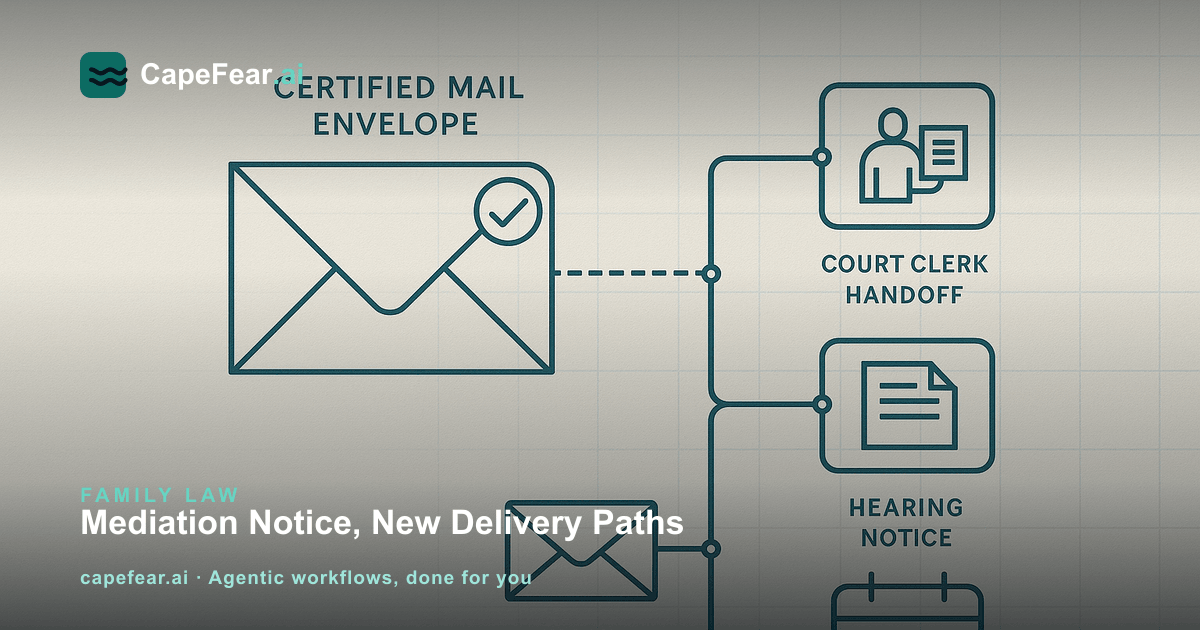
For decades, California courts have had exactly one required way to tell a parent that a contested custody or visitation case is headed to mediation: certified mail, return receipt requested, to the last known address. If the address was stale, the receipt never came back signed, or the parent had moved without updating the court, the notice just sat there. Family law offices know this failure mode well, because they are usually the ones who get the call asking why mediation got scheduled without anyone showing up.
That single-method rule is about to change. AB 2789, signed by the governor and chaptered as Chapter 118 of the Statutes of 2026, amends Family Code section 3176 to let courts use several delivery methods instead of certified mail alone. The new version takes effect January 1, 2027. Until then, certified mail is still the only method courts are required to use.
What the new notice rule actually allows
Once AB 2789 takes effect, a court can give notice of mediation in a custody or visitation case through any of these:
- In-person delivery by court staff when all parties are present at a hearing
- In-person delivery by court staff when a party is physically at the courthouse
- Inclusion in a hearing notice or order that the clerk already files and serves
- Mail, express mail, overnight delivery, or fax
- Electronic service on represented parties, or on self-represented parties who consent to it
The bill was sponsored by the Judicial Council, which had flagged certified mail as a slow, costly, single point of failure for something as routine as a mediation referral. The notice itself also has to keep doing two things it already does under current law: tell the parties that communications with the mediator are confidential, and, where there is a documented history of domestic violence or an active protective order, tell the party who is alleging the abuse (or protected by the order) that they can request separate meeting times with the mediator so they are never in the room with the other party.
Why this is a bigger deal for your intake process than it looks
A notice-delivery rule sounds procedural, but it sits right at the point where family law firms already lose the most time: tracking whether a client actually received something the court sent, and whether the firm needs to follow up before a deadline passes. Electronic service on represented parties is new. That means the notice of mediation may start arriving as an email to your firm, not a certified letter to the client's house, and whoever is monitoring that inbox needs to catch it, confirm the mediation date, and get it onto the client's calendar on the same day.
It also changes what "we never got notice" looks like as a defense or a complaint. Right now, a bounced certified letter is an easy, visible failure. Once a court can satisfy notice by handing a parent a paper at a hearing, or serving it electronically on counsel, the paper trail looks different, and a firm that isn't logging exactly how and when notice arrived has a harder time reconstructing what happened if a client later says they never knew about mediation.
What to check before January 1, 2027
Three things are worth doing now, not next December:
- Confirm your e-service settings are current. If the court can now serve a mediation notice electronically on represented parties, your firm's service email on file needs to be one someone actually monitors, not a shared inbox nobody owns.
- Add a mediation-notice checkpoint to intake. Whoever opens a new custody or visitation matter should ask, on day one, whether the client has already received a mediation referral and through which method, so nothing arrives and sits for a week.
- Document receipt the same way regardless of method. Whether notice came by certified mail, hearing handout, or email, log the date, the method, and who confirmed it. That consistency is what protects the firm if a client disputes timing later.
This is the kind of multi-step tracking work that an agentic workflow is built for: watching the inbox a mediation notice is likely to land in, flagging it against the open matter, drafting the calendar entry and the client update, and handing it to a person to confirm and send. The agent reads and proposes. A person still approves anything that actually goes out or gets filed. If you want to see what that looks like for a family law office, our law firm page walks through the intake and filing workflows we set up, and how it works covers the human-approval step in more detail.
Sources: RecordingLaw, "California AB 2789 Changes How Courts Must Notify Parents of Custody Mediation"; CalMatters Digital Democracy, AB 2789 bill record.