Why Dental Practices Lose Revenue to Patients Who Already Said Yes
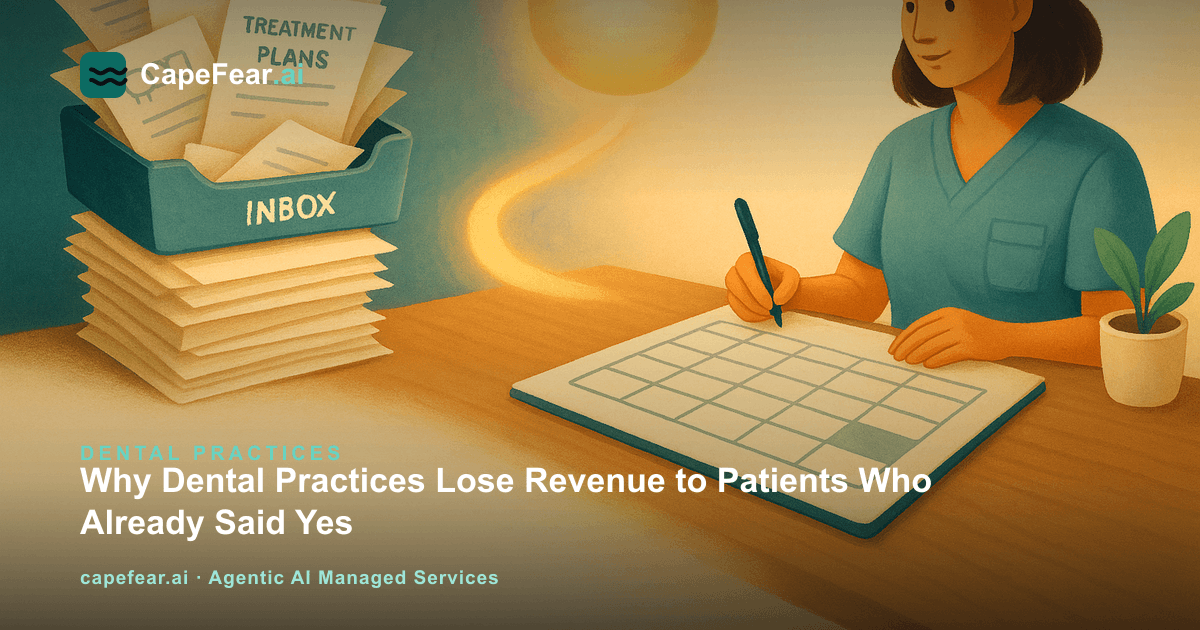
There is a revenue problem in most dental practices, and it has nothing to do with attracting new patients. It is sitting in the practice management software right now, in the form of accepted treatment that was never scheduled.
The numbers are significant. Research from Henry Schein One puts it plainly: the average dental practice has $1 million to $1.5 million in annual revenue being left on the table because of unscheduled treatment. Patients said yes during their appointment, the clinical team did the work of diagnosing and recommending, and then the follow-through never happened. The chart was closed. The patient walked out. And the practice moved on.
This is different from a patient acquisition problem. It is already-earned trust that expired quietly.
Two lists that most practices underwork
There are two overlapping groups worth separating in any recall and follow-up effort.
The first group is patients who accepted a treatment plan but never booked the procedure. Life got in the way, or they left meaning to call, or the front desk was busy and the follow-up never went out. Only about 46% of proposed treatment plans are accepted on average across the industry, and of those, a meaningful share never convert to a scheduled appointment. Data from Henry Schein One shows that outreach within three days of the original visit improves case acceptance by 10% or more, but that window closes fast when the team is running between rooms.
The second group is dormant patients: people who used to come in regularly and quietly stopped. Ainora's 2026 dental recall benchmarks found that the average practice carries 800 to 2,000 dormant patients (those who have not visited in 12 months or more), and that group represents 30 to 50% of the total patient base. A practice with 1,200 dormant patients is sitting on roughly $720,000 to $960,000 in potential revenue. Reactivating 100 of them typically generates $80,000 to $150,000 in first-year collections. Reactivation also costs a fraction of new patient acquisition: $10 to $30 per reactivated patient versus $150 to $350 for a new one.
The math is not subtle. The opportunity is already in the database.
Why phone calls alone do not close this gap
Most practices already know they should follow up more. The problem is not awareness; it is bandwidth. The front desk is managing phones, insurance verification, check-ins, and dozens of other tasks at once. Recall calls are real work, and they are easy to defer when today is already full.
The research on outreach frequency makes the case for consistency. A single phone call achieves a 5 to 8% reactivation rate. Multi-touch campaigns using three to five contacts across phone, text, and email reach 15 to 25% reactivation rates. That difference is almost entirely an execution problem. Practices that want better results need more touchpoints, but the front desk has finite hours.
A consistent, automated outreach layer addresses this gap directly. Not replacing the conversation a patient has with a coordinator when they call back, but handling the initial reach-out reliably: sending a message to a patient who accepted a crown recommendation six weeks ago and has not booked, queuing a recall reminder for someone who is 14 months overdue for a cleaning, or flagging a treatment plan that is about to age past the insurance estimate's validity window.
What the agent does (and what a person still handles)
An AI agent built for this kind of work reads the practice management data, surfaces the patients who need outreach and when, and drafts the messages. The front desk coordinator reviews the queue, approves or adjusts each message, and sends it. Nothing goes out without a person in the loop. The agent does not contact anyone autonomously, make clinical decisions, or override the coordinator's judgment.
The value is consistency. The agent runs the same recall logic every morning regardless of how busy the schedule looks. It catches the 90-day follow-up that would otherwise slip. It keeps the dormant patient list from growing silently while the team is focused on today's appointments.
This is also not a system you need to build or operate yourself. The AI agents for dental practices overview covers the full picture, and how it works explains the done-for-you model and the human handoff approach in more detail.
The patients are already in your database. The treatment was already accepted. The only thing standing between that list and booked appointments is consistent, timely outreach. That is exactly the kind of repetitive, clock-sensitive work an AI agent handles well.
Sources: Henry Schein One, "Average Providers Are Losing Hundreds of Thousands in Unscheduled Treatment"; Ainora, "Dental Recall and Reactivation Statistics: Industry Benchmarks (2026)".