
Indiana Just Banned AI-Only Downcoding of Dental Claims. The Rule Cuts Both Ways.
Your front desk has probably felt it already: a claim comes back downcoded, no explanation, no phone call, just a smaller check than the procedure code called for. Dental practices have assumed for a while that an algorithm made that call. Indiana just put that assumption into law, and the law isn't one-sided.
Indiana House Enrolled Act 1271 took effect July 1, 2026. It adds a new chapter to the state's insurance code that bars a health plan from using an automated process, system, or tool, including AI, as the sole basis for downcoding a claim based on medical necessity, without an employee or contractor actually reviewing the patient's record first. The plan also has to tell the practice when a claim gets downcoded, and it can't downcode based on a diagnosis code alone. Practices get an appeals process, and they can batch downcoded claims instead of appealing one at a time.
The part most coverage skips: it binds your practice too
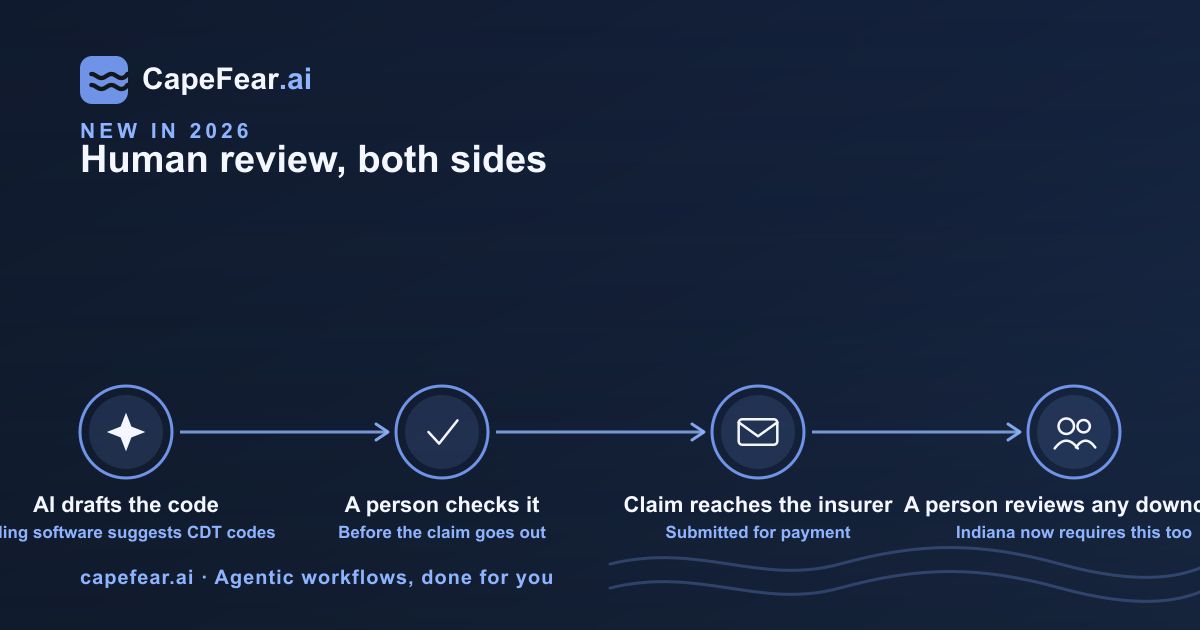
The same chapter includes a mirror provision on the provider side. It prohibits a practice from using an automated process, system, or tool to submit a claim without a person involved in preparing that claim reviewing it first. If your billing software auto-generates CDT codes from chart notes and submits on its own, Indiana's law says that workflow needs a human checkpoint before the claim goes out, not just before the insurer's decision comes back.
That's a narrower ask than it sounds. It doesn't ban automated coding tools. It says a person has to look at what the tool produced before it becomes a claim. Most practices already have someone glance at a claim before submission. The law just makes that step a requirement instead of a habit, and it gives you a paper trail if a payer ever disputes what you billed.
Indiana isn't the only state moving here
The American Dental Association reported in September that 18 states had enacted 33 new dental insurance reform laws in 2026, with more expected before year end, and downcoding has been one of the recurring targets. Coverage of Indiana's law also points to Alabama, Utah, Washington, Maryland, and Georgia enacting measures that require a qualified human, not an algorithm alone, behind an adverse claims decision, with similar downcoding bills introduced this year in California, Connecticut, Illinois, Maryland, Missouri, and Oregon. Maryland's insurance regulator separately found a major payer had improperly downcoded evaluation and management claims and ordered it stopped. The direction is consistent even where the bill numbers differ: insurers are being told a machine can't make the final call on a claim by itself, and several of those same states are starting to ask the same of providers.
If you're not in Indiana, the practical move isn't to wait for your own state's version. It's to check whether your current claims workflow already has a documented human review step before submission, because that's the part a law like this one is built to check.
Where this fits with how we set up practice workflows
This is the same shape we build into every billing or intake workflow we set up: software does the drafting, a person checks the output before anything goes out the door. For claims specifically, that means a staff member reviews the CDT codes an automated tool suggests before the claim is submitted, and a flagged downcode gets routed to a person to decide whether it's worth appealing, with the batching option Indiana's law allows. None of that requires new software. It requires the review step to be a defined point in the process rather than whoever happens to catch it.
See how we set this up inside the tools a practice already uses on how it works, or what this looks like specifically for dental front-desk and billing workflows on our dental page.
Sources: Dental Economics, "2026 dental insurance reforms: What practices need to know about getting paid"; Physicians Practice, "Indiana's AI downcoding law"; ADA News, "400 laws and counting: Dental advocacy is driving change".