Two Dental Office Admin Tasks That AI Agents Can Handle Right Now
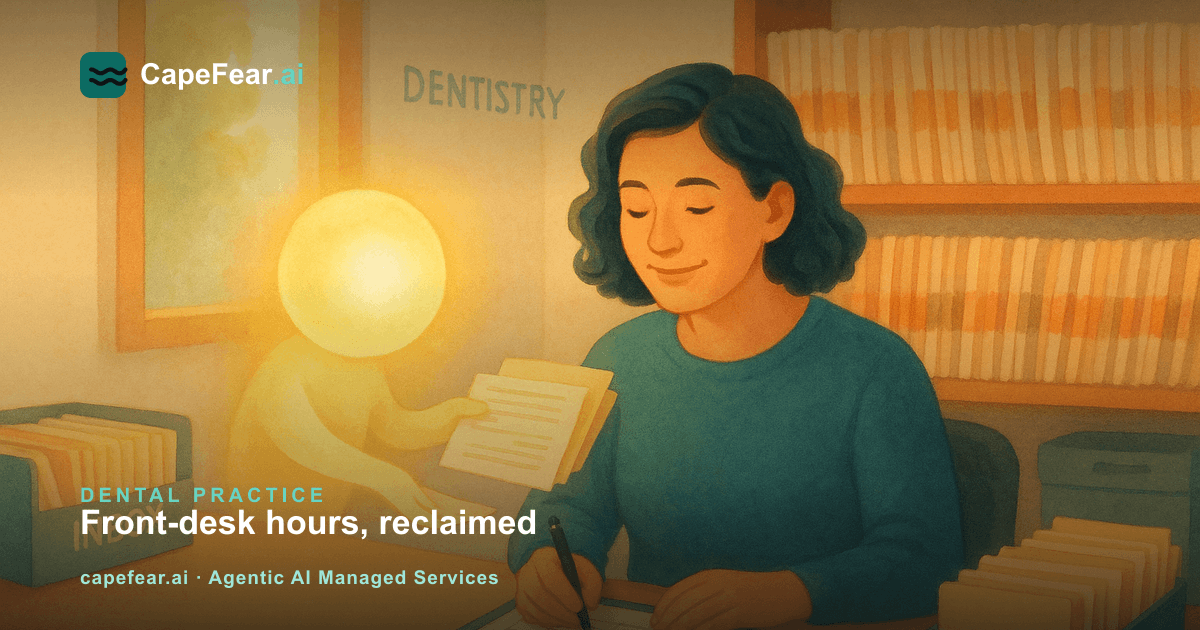
If your front desk team feels perpetually behind, two workflows are probably responsible for most of it: insurance verification and appointment reminders. Both are repetitive, time-consuming, and completely separate from any patient care. Both are also a good fit for AI agents.
This post is not about replacing your front desk. It is about giving them back a few hours each day so they can focus on the work only a person can do.
Insurance verification: the hidden time drain
Verifying insurance benefits before a patient arrives is not optional. If you skip it, you risk billing errors, claim denials, and unhappy patients who thought a procedure was covered when it was not.
The problem is the time it takes. Traditional verification involves calling the insurance company, navigating an automated phone tree, waiting on hold, and then manually transcribing what you hear into your practice management system. According to Curve Dental, that process runs between 15 and 30 minutes per patient.
For a practice seeing 20 patients a day, that is four to ten hours of front-desk time consumed by a single task before the day even starts.
Verification also generates a secondary error risk. When someone is transcribing eligibility details by hand during a phone call, mistakes happen. A wrong deductible figure or a missed frequency limitation creates a claim that comes back denied weeks later, requiring more staff time to appeal.
AI agents can connect to the same clearinghouse data your billing software already uses, pull a patient's current benefits, and write the result into a structured note your team reviews before the appointment. The agent flags anything that needs a human call (an inactive policy, a missing plan ID, an unusual limitation) and handles the routine cases automatically. Nothing posts to a patient record without a person reviewing it first.
The result is not zero human involvement. It is human involvement only where it is actually needed.
Appointment reminders: the other half of the equation
Dental no-show rates vary by practice type and patient population, but the industry average sits around 14 percent. A study published in Dental Tribune, analyzing more than 1.6 million appointments across 64 dental practices, found that automated reminders reduced no-shows by nearly 23 percent compared to manual methods.
That difference matters more than it might look on paper. A missed appointment slot does not just cost the revenue for that procedure. It wastes prep time, disrupts the schedule, and means a patient who needed care did not get it.
The standard reminder workflow (a staff member calling through the next-day schedule each afternoon) is time-consuming and inconsistent. It is also one of the first tasks that gets skipped when the office gets busy.
An AI agent running a reminder sequence handles this consistently regardless of how the rest of the day went. It sends a reminder at the right interval, tracks who responded and who did not, and surfaces the unconfirmed slots for a staff member to follow up on directly. The agent does not make judgment calls or send anything that has not been set up and approved by your team. It handles the routine confirmations and prepares the short list of follow-up calls, so that work becomes a 10-minute task instead of an hour-long one.
Why these two tasks specifically
Not every task is a good fit for AI agents. The best fits share a few properties: the task is repetitive, the inputs follow a predictable pattern, the output goes to a person before anything consequential happens, and errors are catchable before they cause real harm.
Insurance verification and appointment reminders meet all of those criteria. They are not judgment calls. They are data lookups and scheduled outreach. The person still decides what to do with the result. The agent handles the retrieval and the sequencing.
Other front-desk tasks (handling a billing dispute, explaining a treatment plan, or talking a nervous patient through what to expect) are not a good fit. Those require judgment, empathy, and a real conversation. The goal is to make sure those conversations happen, and that your team has the time and energy for them.
Getting started without overhauling your practice
The practical approach is to start with one workflow, prove it works in your specific setup, and expand from there. You do not need to replace your practice management software or commit to a large implementation project.
A useful first step is a simple time audit. For one week, have your front-desk team track how many minutes they spend per patient on verification, and how long the reminder outreach takes each afternoon. The actual number is usually surprising, and it gives you a concrete baseline to measure against.
From there, the conversation about what to automate and how to fit it into your existing tools gets much more concrete. You can read more about how we approach this at AI agents for dental practices, or see the general approach at how it works.
Sources: Curve Dental: What's Really Slowing Down Your Dental Office? | Dental Tribune: Study on automated appointment reminders and no-show rates